Showcasing women in scientific research
A researcher in my class
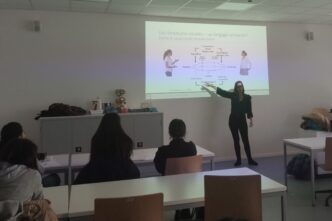
Female researchers associated with the NCCR Evolving Language have invited themselves in a few classrooms in Geneva through the “A researcher in my class” project! With students between 15 and 20 years old, they talked about neurosciences, language evolution, human behaviour, as well as what it is to be a researcher, especially as a woman.
Why it is important to us
Gender stereotypes still exist in our society and affect the way we perceive the world and ourselves. For instance, do you know that, in Swiss universities, women represent 86,5 % of applied linguistics’ students while only 13,5% are in engineering and IT? (Source: Federal statistic office, 2022). Aware of this societal bias, the NCCR Evolving language is involved in the new initiative of the #NCCRWomen campaign “A researcher in my class”. For this matter, female researchers from our NCCR discuss their journey and their work in Swiss secondary schools to empower and encourage teenage girls into scientific careers.
Meet our researchers
 I am interested in the evolution of primate social behaviours with a main focus on cultural transmission and cognition. I am the Director of the Inkawu Vervet Project in South Africa, an experimental field site with a study population of over 200 wild vervet monkeys. For more information on my research, please visit the webpage of my group.
 My research is focused on game mechanisms during the learning how to read in children from 7 to 12 years old. In the NCCR Evolving Language, I am participating in the project EduGame, which questions the importance of executive functions in learning how to read. More precisely, the aim of the project is to understand if training using an action video game, specifically developed in our lab, can help children focus better. We hope to strengthen cerebral pathways involved in reading-related skills, and understand the role of focus skills in reading.
 Through millions of years of evolution, vocal emotions became primordial to species survival (Homo sapiens included). Enabling the transfer of information in a dense environment (e.g. urban or vegetal jungle) and long distances, vocal production is a preferred channel for emotional communication. With the existence of common neuronal and behavioral mechanisms between species, could we, as humans, recognize the vocal emotions of other species ? Especially those of our closest cousins, the great apes ?
 In my research, I’m interested in the interactions between language and other abilities. For example, during my doctoral thesis, I looked at the links between our memory and language, including multilingualism. As a post-doctoral researcher at Unige, I’m focusing on how our brains process and execute verbal instructions, with particular emphasis on the pathway our brains take to decipher the meaning of the instruction through to the motor implementation of the response.